Once your American flag has become worn, it is important to dispose of it in a respectful manner. This guide covers every accepted method — burial, burning, and organized retirement.
"The flag, when it is no longer a fitting emblem for display, should be destroyed in a dignified way, preferably by burning."
— United States Flag Code, 4 U.S.C. § 8(k)
In 1976, Congress amended the Flag Code to include the statement that the U.S. flag is a living entity and, as such, has all the rights thereof — including the right to exist and expire with dignity.
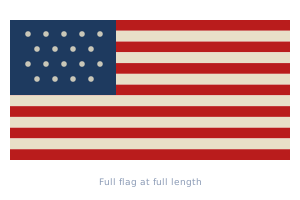
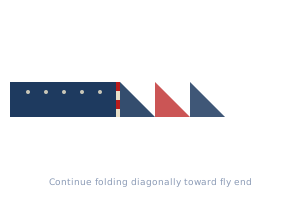
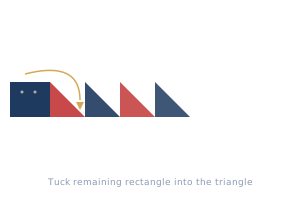
A flag may be buried. Fold the flag in the ceremonial triangle and place it within a sturdy wooden box. The box must then be buried several feet underground.
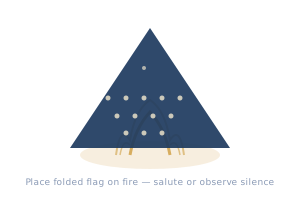
Fold the flag in the ceremonial triangle and place it in a fire. No part of the flag may touch the ground. The flag must be burnt completely and the ashes buried.
Put your flag in a flag retirement box. These boxes are managed by local organizations such as The American Legion, Veterans of Foreign Wars, Girl Scouts of the USA, or Scouts BSA. If you don't know where to find a collection box, contact one of these groups directly.
It is traditional to pay respects by saluting, observing a moment of silence, or reciting the Pledge of Allegiance. After the flag has burned completely, the fire can be put out or allowed to burn out on its own. The ashes should then be buried.
Flags retired with Scouts BSA are generally burned in a reverent ceremony held several times a year. Troops follow a formal script that guides participants through a solemn and structured service.
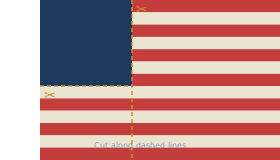
Some Scout BSA troops also recycle flags rather than burn them. To do this properly, the flag must be cut in the appropriate manner before it is processed.
Read the BSA Ceremony Script ↗The appropriate way to cut an American flag separates the union from the field of stripes before the material is recycled.
"The flag, when it is no longer a fitting emblem for display, should be destroyed in a dignified way, preferably by burning."4 U.S.C. § 8(k) — United States Flag Code
In 1976, Congress amended the Flag Code to include the statement that the U.S. flag is a living entity and, as such, has all the rights thereof — including the right to exist and expire with dignity.
The United States flag must always be treated with honor and respect, as it represents those who fought and sacrificed their lives for the rights and freedoms of the American people. A dignified retirement is the final act of that honor.
Yes. A flag may be buried or burned at home, provided you follow the proper folding procedure and treat the act with dignity. For burial, fold the flag in the ceremonial triangle and place it in a sturdy wooden box, then bury it several feet underground. For burning, fold the flag in the ceremonial triangle, ensure no part touches the ground, and allow it to burn completely before burying the ashes.
No. Never burn a flag made of nylon or polyester — the smoke contains harsh chemicals. For synthetic flags, recycling is the preferred and more environmentally conscious method. Contact a local organization for guidance on recycling programs.
Section 8(k) of the United States Flag Code states: "The flag, when it is no longer a fitting emblem for display, should be destroyed in a dignified way, preferably by burning." In 1976, Congress amended the Flag Code to include the statement that the U.S. flag is a living entity with all the rights thereof, including the right to exist and expire with dignity.
Flag retirement collection boxes are maintained by local organizations including The American Legion, Veterans of Foreign Wars, Girl Scouts of the USA, and Scouts BSA. If you cannot locate a collection box near you, contact one of these organizations directly — they can direct you to the nearest drop-off point.
The U.S. Flag Code specifies burning as the preferred method. However, other accepted methods include burial (folded in a ceremonial triangle inside a sturdy wooden box, buried several feet underground), shredding, and recycling. For nylon flags, recycling is preferred over burning due to the toxic fumes synthetic materials produce.
Yes. Flags retired with Scouts BSA are generally burned in a reverent ceremony held several times a year. Many troops follow a formal script for the ceremony. Some Scout BSA troops also recycle flags — to do so, the flag must be cut in the appropriate manner before processing.